Indonesia forest fires: Smoke crosses the sea, affects 3 countries; social and economic impact estimated at about ¥147.5 billion ($983 million)
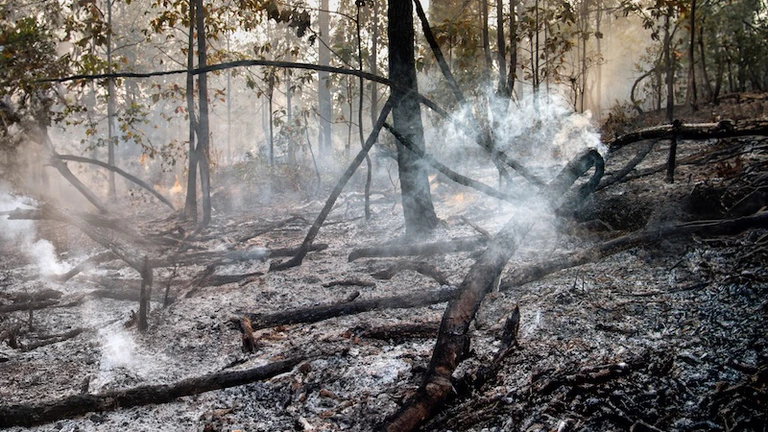
Underground peat fires and seasonal winds carry smoke across the sea
The nature of peatland fires and seasonal winds are closely linked to the widespread air pollution.
Peatlands across Sumatra and Kalimantan can smolder not only on the surface but also underground when they dry out, producing smoke for extended periods. Seasonal winds that change direction carry the smoke across the sea.
Singapore's meteorological authorities said on October 15 that southeasterly winds were carrying smoke from Kalimantan toward Singapore.
This means that even areas far from the fire sources can see their skies shrouded in smoke when the wind shifts. The combination of fire locations and wind direction determines how pollution spreads across borders.
smoke spread_20261023-768x432.webp)
Two routes carry smoke across the sea to nearby cities
The current haze is spreading along two main routes across the sea.
The first route comes from Sumatra. Smoke from fires in the island's eastern and southern areas flows across the Strait of Malacca toward the Malay Peninsula and Singapore.
The second route comes from Kalimantan. Smoke spreads to areas such as Malaysia's Sarawak state and is also carried by the wind across the sea toward Singapore.
The combination of the two sources and wind direction means the areas covered by smoke can change rapidly. Even urban areas separated from the fires by the sea can quickly become corridors for smoke, bringing pollution directly into places where people live and work. Since the affected areas continually shift with wind direction and fire conditions, it is important to closely monitor winds aloft.
Social and economic impact across 3 countries estimated at about ¥147.5 billion ($983 million)
Weathernews estimates, based on publicly available information through October 19, 2026, put the combined impact across the three countries at about ¥147.5 billion ($983 million).
By country, the impact was estimated at about ¥16.4 billion ($109 million) in Indonesia, ¥55.1 billion ($367 million) in Malaysia and ¥76 billion ($507 million) in Singapore.
In Indonesia, where the fires originated, the impacts are primarily direct losses, such as damage to plantations and firefighting costs. In neighboring countries, however, indirect effects on health, labor, logistics and tourism have mounted. School closures have taken place in Kuala Lumpur and Malaysia's Johor state, and flights connecting the two countries have been canceled.
The estimates point to a particular feature of cross-border pollution: impacts are more severe in areas where urban functions are concentrated.
Indonesian wildfire economic impact_20261023-1600x900.webp)
290 animals rescued after habitat loss; ecosystem damage cannot be measured in money
The effects of forest fires extend beyond human health and economic activity.
Fires have also occurred in Tanjung Puting National Park on Kalimantan, home to orangutans. In West Kalimantan and elsewhere, wildlife including pangolins and proboscis monkeys have been rescued in successive incidents.
Indonesia's Ministry of Forestry said that 290 wild animals had been rescued nationwide by October 8, with measures taken to move them to safe habitats and provide protection and rehabilitation. In other words, the fires are not only reducing forests to ash; they are also destroying the vegetation that provides animals with food and shelter.
Such destruction of the natural environment represents long-term losses that cannot be fully captured by the estimated economic damage.
Watch for wind shifts and rainfall that could affect the spread of haze
The course of air pollution will depend on more than whether fires at the source are brought under control.
Changes in broader wind patterns and rainfall will also be key. October is a seasonal wind transition period in Southeast Asia, and shifts in wind direction can change which countries and regions receive smoke. Smoke could begin reaching cities that have so far been less affected, making it important to monitor wind patterns.
More rainfall is expected to help prevent fires from spreading and reduce smoke in the atmosphere, but fires may continue burning underground in peatlands. Even when rain falls at the surface, hotspots may smolder deep underground, and smoke could rise again as winds carry it. For that reason, it is important to continue monitoring both rainfall in fire-hit areas and wind direction, which carries smoke to neighboring countries.
Basis and method for the estimates
Based on publicly available information through October 19, 2026, Weathernews converted into monetary terms both the direct impacts, such as damage to forests and plantations and firefighting costs, and the indirect impacts of haze on health, labor, logistics and tourism.
The calculation assumes a 10-day period of haze impacts and combines estimates of the affected population and the economic scale of different industries with assumptions including a 12% increase in medical visits and a 6% decline in labor productivity.
This is an independent estimate based on certain assumptions, not a confirmed damage total issued by a public agency. Actual impacts vary with weather conditions and social activity, and some overlap between the estimated items is possible. ※Currency conversion is calculated at US$1 = ¥150.
Main sources and reference information
ASEAN Specialised Meteorological Centre (ASMC): Forest fire and transboundary haze monitoring; seasonal wind and weather outlooks
Meteorological Service Singapore (MSS) and National Environment Agency (NEA): Haze conditions and direction of smoke transport on October 15, 2026
Malaysia Department of Environment (DOE): Transboundary haze conditions and air pollution index
Malaysia Ministry of Education (KPM) and state education authorities: School closures due to air pollution in October 2026
Firefly: Information announced on October 12, 2026, about cancellations on the Subang–Seletar route
Indonesia's Ministry of Forestry and National Disaster Management Agency (BNPB): Forest and peatland fires, firefighting, and wildlife protection and rescue
International Fund for Animal Welfare (IFAW): Report on impacts on wildlife dated September 18, 2026
Health authorities in each country: Publicly released information on health impacts

- Sat, 31/10Max 24° Min 14°

- Sun, 01/11Max 20° Min 13°

- Mon, 02/11Max 18° Min 13°

- Tue, 03/11Max 22° Min 13°

- Wed, 04/11Max 15° Min 12°
- Thu, 05/11Max 17° Min 12°

- Fri, 06/11Max 22° Min 14°

Latest News