Global temperatures hit a record high in August as El Niño drives exceptionally warm sea-surface temperatures
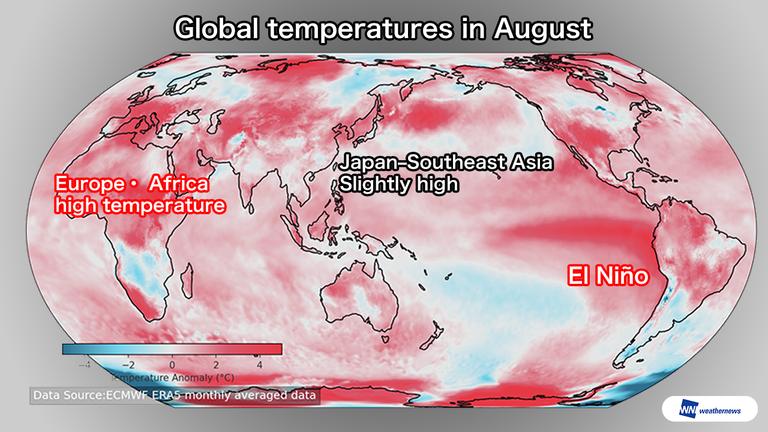
August 2026 was the hottest on record, surpassing 2023 and 2024
Global land temperatures in August 2026 were 1.84°C above the 20th-century average (baseline), making them the second-highest in the 177-year record, behind 2024. Sea-surface temperatures were 1.08°C above the baseline, the highest on record across all months.
The combined global average of land and sea-surface temperatures was 1.32°C above the baseline, surpassing the records set in 2023 and 2024 and making August 2026 the hottest August since statistics began in 1850. August temperatures have been above the baseline for 48 consecutive years, and all 10 of the hottest Augusts on record have occurred since 2016.
▼ Global temperatures in August over the past five years (deviations from the 20th-century average) 2026 +1.32°C (1st) 2025 +1.12°C 2024 +1.24°C (tied for 2nd) 2023 +1.24°C (tied for 2nd) 2022 +0.92°C
North America and Africa record their hottest Augusts ever
North America and Africa both recorded their hottest Augusts since records began. North America exceeded its 2023 record by 0.30°C, while Africa substantially surpassed its previous record by 0.55°C, with exceptionally high temperatures.
Europe as a whole experienced its fourth-hottest August on record, with countries across the continent hit by severe heat waves.
El Niño intensification boosts high temperatures
Global sea-surface temperatures in August were 1.08°C above the baseline, exceeding the previous all-month record by 0.05°C and setting a new record. Monthly sea-surface temperature records have been broken for three consecutive months.
Record-high sea-surface temperatures are spreading across the central and eastern tropical Pacific, and El Niño is continuing and strengthening. According to NOAA's Climate Prediction Center (CPC), there is a more than 90% chance that El Niño will develop into a "very strong" event from autumn through winter in the Northern Hemisphere.
The supply of heat from the oceans to the atmosphere remains extremely elevated and is believed to be strongly driving the record-high global temperature trend.

- Sat, 24/10Max 20° Min 14°

- Sun, 25/10Max 25° Min 13°
- Mon, 26/10Max 21° Min 13°

- Tue, 27/10Max 15° Min 6°
- Wed, 28/10Max 13° Min 3°
- Thu, 29/10Max 15° Min 6°
- Fri, 30/10Max 18° Min 6°

Latest News