

Wildfires in 3 European countries: social and economic impacts estimated at about ¥560 billion (about €3.1 billion)
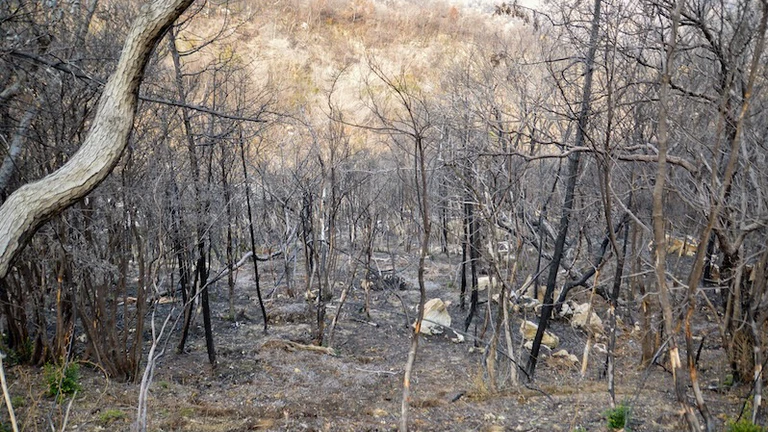
※The estimates are based on amounts in yen, with euros converted for reference at a rate of ¥180 to €1. Since the euro conversions use yen estimates before rounding, the displayed figures for individual countries may not add up to the total due to rounding.
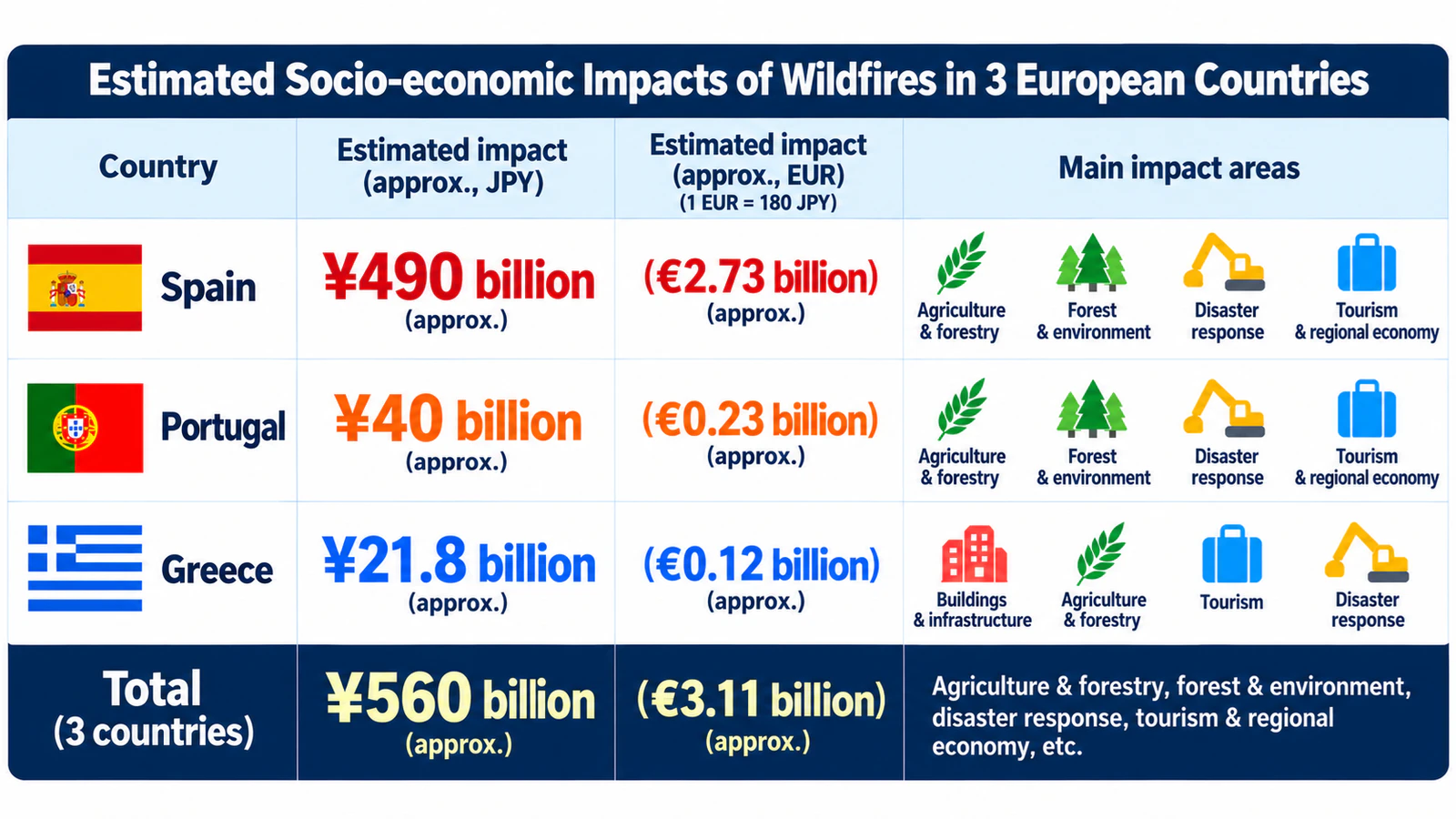
Spain: About 280,000 ha of forest burned, with damage spreading to agriculture
Spain had the highest estimated impact of the three countries, with large-scale forest fires far exceeding normal levels.
According to a provisional tally by Spain’s Ministry for Ecological Transition and the Demographic Challenge (MITECO) as of September 28, about 276,000 ha of forest had burned in 2026—about 2.5 times the average for 2016–2025. Authorities also confirmed 45 large forest fires covering more than 500 ha each.
The fires extended beyond forests and directly hit food production. According to Spain’s Ministry of Agriculture, Fisheries and Food (MAPA), about 60,000 ha of the roughly 270,000 ha affected by fires was agricultural land. Damage extended to crops, livestock grazing land, beekeeping facilities and rural infrastructure, dealing a major blow to the foundations of local economies.
Portugal: Grapes and other crops affected, with concerns over soil erosion and environmental damage
Severe wildfires broke out repeatedly in Portugal over the summer, causing major damage to important farmland as well as forests. Impacts on agricultural production—including grapes, olives and almonds, all local specialties—have been reported in affected areas, directly threatening local livelihoods. The Portuguese government is providing recovery assistance to restore agricultural production capacity.
Secondary damage after the fires are extinguished is also a concern. The loss of trees on hillsides has left lasting environmental challenges, including soil erosion during heavy rain and declining water quality as sediment enters rivers. The loss of forests also removes their ability to regulate water and protect the environment, risking a long-term deterioration in living conditions.
Greece: Damage to essential infrastructure and a blow to local economies during peak tourist season
Wildfires broke out in parts of Greece from late July through August, directly damaging homes, local businesses and farmland that support people’s daily lives. The Greek government is moving quickly to provide financial assistance and other support to affected homes, businesses and agricultural operators, helping residents and business owners rebuild their lives and livelihoods.
The fires were especially serious because they occurred during the peak of the summer tourist season, when demand is at its highest of the year. Residents and many tourists were forced to evacuate, while restrictions on shops and accommodation facilities may have had wide-ranging adverse effects on tourism-related businesses, a key local industry. Disruptions to infrastructure caused by weather disasters are developing into a crisis that threatens the wider local economy through supply chains and tourism.
Wildfire damage continues after the flames are out, with soil erosion and industry recovery among the challenges
The threat from wildfires does not end when the flames are extinguished. According to EFFIS, the area burned within the EU reached about 679,000 ha as of September 23, nearly twice the average of about 355,000 ha for the same period over the past 20 years. With such extensive areas of nature lost, a return to normal social activity is expected to take many years.
Restoring production in affected agriculture and forestry, and rapidly repairing damaged homes and infrastructure, are urgent priorities. Long-term challenges also include sediment and hazardous ash flowing from burned areas stripped of vegetation, ecosystem recovery and the restoration of tourism demand.
Fires fueled by increasingly extreme weather continue to threaten not only ecosystems but the economic structures of human society itself.
Basis and method for the estimates
The estimates convert the main impacts identified in each country into economic values, drawing on publicly available information, including burned area, population and economic statistics, and data on agriculture and forestry. The impacts covered include agriculture and forestry, forests and the environment, buildings and infrastructure, disaster response, tourism and local economies.
The estimates were also checked against actual data released by national governments and public agencies after the summer. Some impacts on people and damage to buildings were excluded from the figures in this article where they differed substantially from publicly available information. Their exclusion from the calculations does not mean that no such damage occurred.
These are estimates independently calculated by Weathernews based on specific assumptions, not final damage totals issued by public agencies. The estimates are based on amounts in yen, with euros converted for reference at a rate of ¥180 to €1.
Main sources and references
・European Commission Joint Research Centre (JRC) / European Forest Fire Information System (EFFIS): 2026 wildfires and burned area in Europe
・Spain’s Ministry for Ecological Transition and the Demographic Challenge (MITECO): Provisional 2026 forest fire tally
・Spain’s Ministry of Agriculture, Fisheries and Food (MAPA): Information on agricultural damage and support following wildfires
・Portuguese government / Institute for Nature Conservation and Forests (ICNF): Wildfire and recovery assistance information
・Greece’s Ministry of Climate Crisis and Civil Protection: Wildfire and assistance information for affected people
・2026 wildfire-related information released by national governments, local authorities and other bodies

- Thu, 22/10Max 23° Min 23°

- Fri, 23/10Max 27° Min 23°

- Sat, 24/10Max 28° Min 23°

- Sun, 25/10Max 32° Min 25°

- Mon, 26/10Max 33° Min 25°

- Tue, 27/10Max 26° Min 21°

- Wed, 28/10Max 24° Min 20°

Latest News

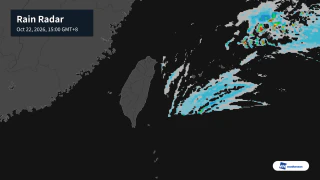 80% Chance of Rain in Taipei Tomorrow; Evening Rain in Hualien; Clear in Kaohsiung and Taichung
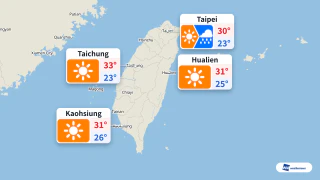 Taipei forecast to turn from sunny to rainy today; 90% chance of rain at 15:00
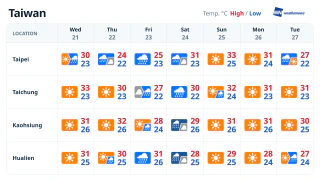 Weekly forecast: Front passes on the 21st, rainfall varies across regions
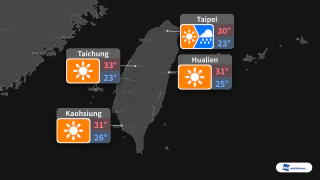 Tomorrow, 10/21: Taipei to Turn Rainy; Sunny in Taichung, Kaohsiung and Hualien