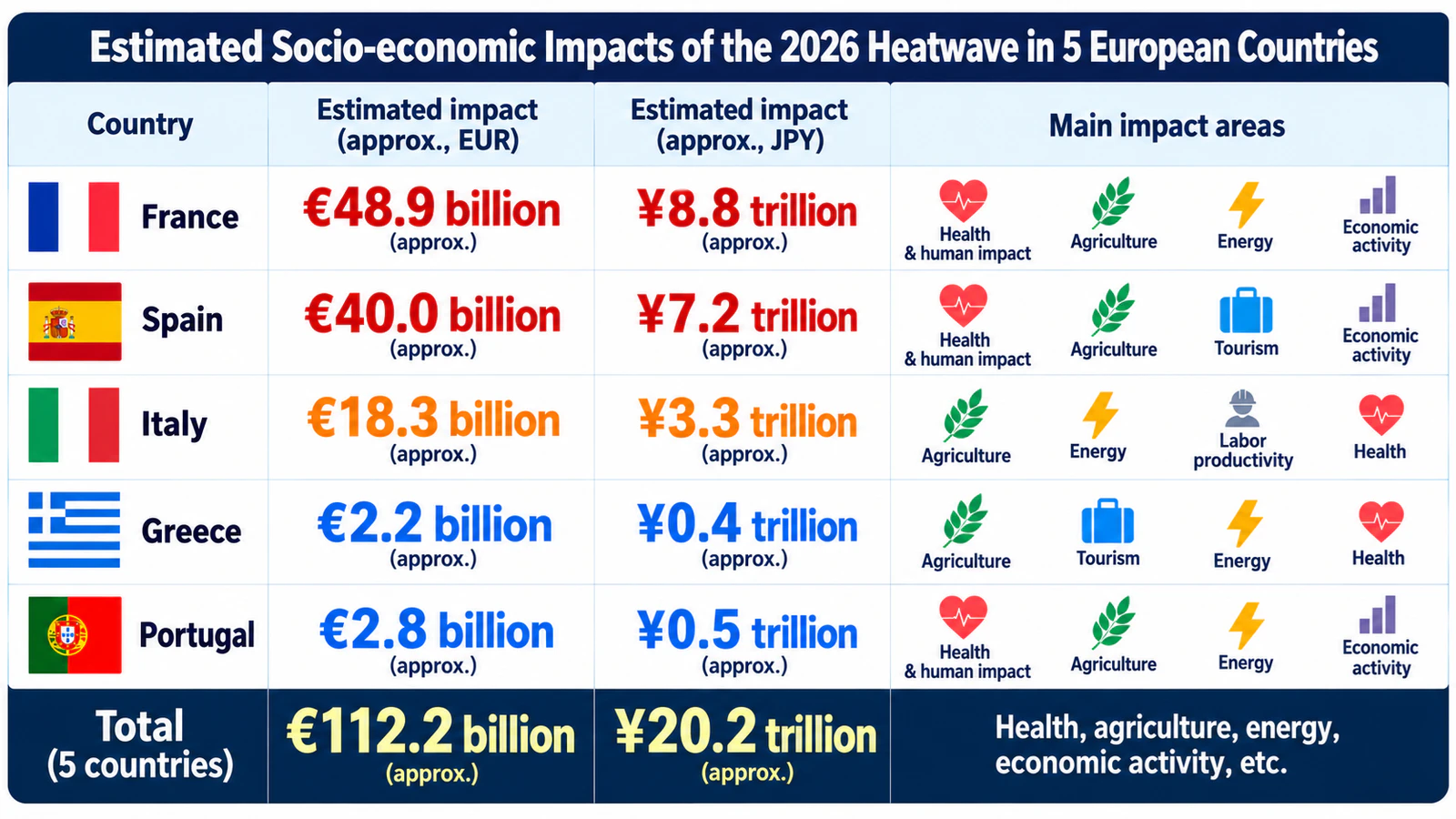
Heatwave impacts in five European countries estimated at ¥20.2 trillion (about €112.2 billion)

Social and economic impacts in the five countries estimated at about ¥20.2 trillion
- Estimates are based on yen, with euros converted for reference at €1 = ¥180. Figures for each country are approximate and may not add up to the total due to rounding. Direct damage from wildfires is calculated separately.
Heat and dry conditions hamper crop growth, dealing a clear blow to agriculture
A report published on September 28 by the European Commission’s Joint Research Centre (JRC) highlighted agricultural damage from summer heat and a lack of rainfall.
Drought lowered soil moisture across western and central Europe, accelerating crop development. As a result, grains and tubers did not grow sufficiently. Some areas saw sharply reduced yields, while in others crops were left unharvested.
The JRC’s outlook as of September projected that yields for major EU summer crops would be below the five-year average: 15% lower for soybeans, 14% for green maize, 11% for sugar beet, 8% for grain maize and 7% for potatoes.
Declines in grassland and animal feed are also raising concerns about impacts on livestock farming.
France: Repeated heatwaves push deaths far above the level normally expected
France experienced several heatwaves over the summer, with a severe toll on human life.
According to Santé publique France, deaths during the heatwave periods were substantially higher than normally expected. An estimated 5,764 excess deaths occurred from June 17 to July 2, 1,243 from July 3 to 22, and 817 from July 27 to August 20—an increase of more than 7,800 deaths in total.
These figures do not directly count deaths from heatstroke or other heat-related causes. They are statistical estimates of how many more people died during the heatwaves than would normally have been expected. They show the considerable strain extreme weather placed on the health infrastructure.
Spain: Hottest summer since 1869, with rainfall at 56% of normal
According to the Spanish State Meteorological Agency (AEMET), the average temperature on mainland Spain from June to August 2026 was 24.5°C, or 2.4°C above normal. It was the hottest summer since 1869.
Several heatwaves occurred, and high temperatures continued into early September. Summer rainfall was also just 56% of normal, marking the country’s third-lowest total since 1961 and a record level of water scarcity.
The combination of severe drought and extreme heat has dealt an unprecedentedly heavy blow to regional industries, including agriculture.
Italy: Cooling demand surges as labor productivity declines
High temperatures and dry conditions affected large areas of Italy over the summer.
A JRC analysis found a substantial increase over normal in the number of days with temperatures above 35°C across much of the country.
The intense heat not only harmed crop growth and water use but also drove a sharp rise in cooling demand, putting pressure on the power grid. It also disrupted outdoor work and reduced efficiency, lowering labor productivity.
Greece: Heat weighs on tourism and agriculture, while activity restrictions burden local economies
Severe summer heat also affected key industries in Greece.
As excessive heat persisted during the summer, when tourism demand is concentrated, daytime outdoor activities were restricted. Changes in travelers’ behavior affected tourism-related businesses.
In agriculture, high temperatures and water shortages hampered crop growth, while a sharp increase in irrigation demand contributed to higher electricity consumption.
Portugal: Water shortages worsen as heatwaves squeeze agriculture and outdoor work
Prolonged heat and dry conditions in Portugal affected agriculture, water resources and electricity demand.
Low soil moisture increased irrigation needs, making access to limited water and energy a major challenge.
Outdoor work, including construction and farm work, was also less efficient as workers had to contend with the heat. Activity in the tourism sector was constrained as well. The estimates also reflect how weather-related productivity losses broadly weighed on economic activity in local communities.
European crop losses may ripple through to food prices, potentially affecting Japanese households
The summer 2026 heatwaves left an estimated ¥20.2 trillion in social and economic impacts, affecting not only people’s health but society and the economy more broadly. Now that summer has passed, concern is shifting to longer-term issues, including reduced harvests and rising food prices.
Poor crop conditions in Europe could ripple through international markets and affect food and restaurant prices in Japan, which relies on imports.
Extreme weather is not a distant problem in another part of the world. It is an issue directly connected to people’s daily lives and household budgets, and warrants continued attention.
Basis and methodology for the estimates
For these estimates, Weathernews used publicly available information, including each country’s weather data, population and economic statistics, and agricultural and energy-related data. The main impacts identified in each country—on people’s health, agriculture, electricity, tourism and labor productivity—were converted into economic values.
The estimates were also checked against actual data published after the summer by national governments and public agencies. Some impacts on people for which there was insufficient supporting evidence were excluded from the figures in this article. Direct damage from wildfires that occurred during the same period is calculated separately.
These estimates are not official final damage figures from public agencies. They are estimates calculated independently by Weathernews based on a set of assumptions. The estimates are based on yen, with euros converted for reference at €1 = ¥180.
Main sources and reference information
European Commission Joint Research Centre (JRC): MARS Bulletin, European Drought Observatory
Santé publique France: All-cause excess mortality during the 2026 heatwaves
Spanish State Meteorological Agency (AEMET): Summer 2026 climate summary
National meteorological agencies, governments and statistical agencies: Population, economic, agricultural, electricity and health statistics

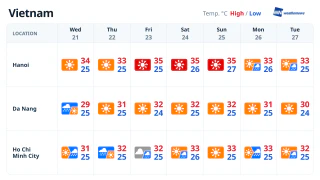
- Thu, 22/10Max 33° Min 25°

- Fri, 23/10Max 33° Min 25°
- Sat, 24/10Max 35° Min 26°

- Sun, 25/10Max 35° Min 26°
- Mon, 26/10Max 35° Min 26°
- Tue, 27/10Max 33° Min 25°
- Wed, 28/10Max 32° Min 24°
Latest News