Indonesia's social and economic impacts from the Anak Krakatau eruption estimated at approximately ¥5.7 trillion
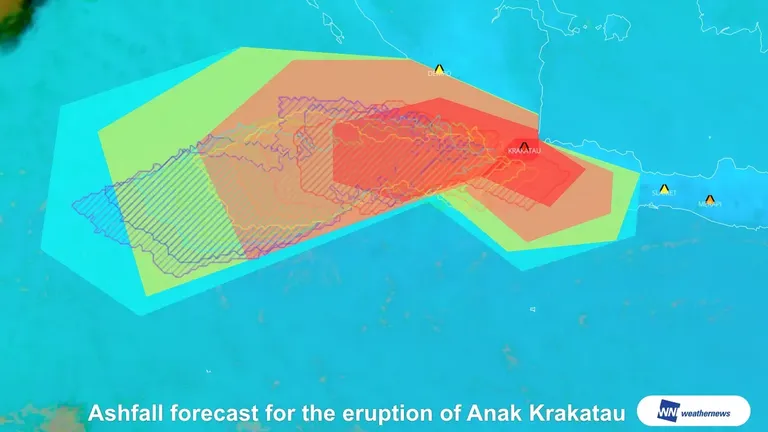
A large-scale eruption occurred at Anak Krakatau volcano in Indonesia's Sunda Strait from the night of September 4, 2026, into the early morning of September 5. The plume containing volcanic ash reached an altitude of approximately 15,000 m, and ash spread across a wide area. Air traffic was also significantly affected, with multiple airports temporarily closed.
Weathernews' independent estimate puts the total social and economic impact in Indonesia from this eruption at approximately ¥5.7002 trillion (approximately US$38 billion). Disaster response and recovery, along with impacts on the environment and forests, account for more than 80% of the total.
Multiple volcanoes active across the country, creating widespread volcanic risk
In Indonesia, active activity is currently being observed at multiple volcanoes across the country, including not only Anak Krakatau in the Sunda Strait, but also Mount Semeru in East Java, Ibu Volcano on Halmahera Island, and Mount Lewotobi Laki-laki on Flores Island. This situation also demonstrates that Indonesia, home to many active volcanoes, faces a risk of volcanic activity causing impacts on society, transportation, industry, and other sectors across a wide area.
The estimated social and economic impact of approximately ¥5.7 trillion does not represent a combined total for these multiple volcanic activities. The estimate covers only the impacts associated with the Anak Krakatau eruption since September 4, 2026.
No tsunami confirmed, but volcanic ash has broadly affected daily life and transportation
Observations from Himawari-9 and other meteorological satellites showed that the plume containing volcanic ash reached an altitude of approximately 15,000 m.
The 2018 eruption caused a tsunami associated with the collapse of the volcano's edifice, but in the current eruption, no sea-surface anomalies that would lead to a tsunami had been confirmed as of the time of calculation.
Meanwhile, volcanic ash carried by the wind spread across a wide area, including the Jakarta metropolitan area. In areas affected by ash, some schools switched to online classes.
In air transportation, multiple airports, including Soekarno-Hatta International Airport, were temporarily closed. According to Indonesia's Ministry of Transportation, by the afternoon of September 7, a total of 2,961 domestic and international flights had been affected by cancellations, delays, route changes, and other disruptions, and approximately 341,000 passengers had been affected. On September 8, operations resumed at airports that had been temporarily closed, but because activity at Anak Krakatau continues, it is necessary to continue monitoring the spread of volcanic ash. In addition, activity is continuing at multiple other volcanoes in Indonesia.
Disaster response and recovery, and the environment and forests, account for more than 80% of the impact
As of the time of calculation, no large-scale destruction of buildings caused by a tsunami or pyroclastic flow, or direct deaths caused by the eruption, had been confirmed in publicly available information. Therefore, this estimate treats the impacts of building damage and deaths as zero for calculation purposes.
Based on this, the impacts of volcanic-ash response, interruptions to daily life and work, industrial activity, transportation and logistics, and other factors were calculated by category under specified assumptions.
Disaster response and recovery costs: approximately ¥2.4857 trillion (US$16.57 billion / 43.6% of the total)
This category accounts for the largest share of the estimate. The impacts on disaster response and recovery by national and local governments—including cleanup of volcanic ash deposited over a wide area, infrastructure inspections and protection, and evacuation response—were converted into economic values under specified assumptions.
Impacts on the environment and forests: approximately ¥2.2194 trillion (US$14.80 billion / 38.9% of the total)
The impacts of volcanic gases, volcanic ash, and other factors on the natural environment were converted into social costs under specified assumptions. Combined with disaster response and recovery costs, this amounts to approximately ¥4.7051 trillion, accounting for more than 80% of the total estimate.
Impacts on communications, daily life, and work: approximately ¥601.8 billion (US$4.01 billion)
The impact on communications and IT was approximately ¥414.3 billion, the decline in labor productivity associated with school closures and voluntary restrictions on going out was approximately ¥145.3 billion, and the impact on medical care and health was approximately ¥42.2 billion.
Impacts on industry, agriculture, forestry and fisheries, logistics, and tourism, among others: approximately ¥281.6 billion (US$1.88 billion)
The impact on manufacturing and commerce was approximately ¥120.4 billion, agriculture, forestry and fisheries approximately ¥74.9 billion, transportation and logistics approximately ¥46.6 billion, tourism and events approximately ¥20.5 billion, and the closure of air routes approximately ¥19.2 billion.
Other impacts: approximately ¥111.7 billion
The impact on insurance payments and finance was approximately ¥111.0 billion, while the impact on energy supply and demand was approximately ¥0.7 billion.
Together, these impacts amount to approximately ¥5.7002 trillion in social and economic impact.
Flights resume, but continued caution is needed regarding volcanic activity
Anak Krakatau remains at Alert Level III (Siaga), the second-highest level.
Operations resumed on September 8 at airports that had been temporarily closed, and air traffic is recovering. However, the volcanic activity itself continues, and depending on future eruptions and wind direction, volcanic ash could again affect a wide area.
The results of this estimate indicate that even when no large-scale building damage or tsunami has been confirmed, the wide-area spread of volcanic ash can have social and economic impacts across a broad range of sectors, including aviation, daily life, industrial activity, and disaster response and recovery.
For businesses and local governments, it is important to continue checking not only the status of the eruption, but also wind direction, forecasts for the spread of volcanic ash, and operating information for aviation and transportation services, in order to ensure safety and prepare for business continuity.
(Reference) Basis and methodology of the estimate
Calculation method: Each category was calculated by setting specified assumptions based on public statistics, such as airport arrivals and departures, passenger numbers, and regional GDP, as well as information published by local media, government agencies, and other sources.
Treatment of direct property damage and human impacts: As of the time of calculation, no large-scale destruction of buildings caused by a tsunami or pyroclastic flow, or direct deaths caused by the eruption, had been confirmed in publicly available information. Therefore, this estimate treats the impacts of building damage and deaths as zero for calculation purposes.
Time of calculation: The social and economic impact amount was calculated based on information confirmed through September 7. Factual information updated afterward, such as flight operating conditions, reflects information as of September 8.
Currency conversion: 1 USD = 150 JPY.
This is a preliminary estimate independently calculated by Weathernews based on information confirmed from September 4 through 7, 2026, and specified assumptions. It is not the actual damage amount or a confirmed figure released by a public agency, and does not represent the actual amount of damage. The estimate may change depending on future volcanic activity, the extent of damage, and new information.
Sources and references
- Darwin Volcanic Ash Advisory Center (Darwin VAAC): Volcanic Ash Advisory
- Japan Meteorological Agency: Information on Distant Earthquakes
- Himawari-9 meteorological satellite imagery (Weathernews Weather News)
- Indonesia's Ministry of Transportation: Impacts on flights and passengers; airport operations information
- Indonesia's Meteorology, Climatology, and Geophysical Agency (BMKG): Volcanic ash dispersion, airport operations, and tsunami monitoring information
- Center for Volcanology and Geological Hazard Mitigation (PVMBG) / Geological Agency of Indonesia: Anak Krakatau volcanic activity information

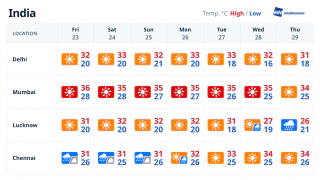
- Sat, 24/10Max 33° Min 20°
- Sun, 25/10Max 33° Min 21°
- Mon, 26/10Max 32° Min 20°
- Tue, 27/10Max 33° Min 18°
- Wed, 28/10Max 32° Min 16°
- Thu, 29/10Max 31° Min 18°
- Fri, 30/10Max 30° Min 19°
Latest News